本页目录On this page
用三个滚转角的 XMM-Newton RGS 前向建模分离展源的空间展宽与视向速度场:N132D 的 O VII 波段Separating spatial broadening from the line-of-sight velocity field of an extended source by forward-modelling three XMM-Newton RGS roll angles: the O VII band of N132D
作者:<作者名单,由 PI 决定>Authors:
0. 摘要0. Abstract
无狭缝光栅光谱仪把天空位置混进波长轴:对展源,谱线的表观宽度同时包含物理速度、源的角延展与仪器响应。XMM-Newton 的 RGS(反射光栅光谱仪)能量分辨率极高,但对几角分的源没有空间分辨。我们提出并检验一个前向建模方法:联合拟合同一目标在三个滚转角的 RGS 第一阶观测,用逐源位置的响应矩阵把天空模板投影成每条抽谱条带的期望计数,并放开四个仪器讨厌参数。标定源审计给出它们的大小:忽略时速度偏差可达 0.5 个标准差;拟掉后残余不超过 0.1 个标准差。应用到 N132D 的 O VII 波段(21.2–22.5 Å,三条条带,约 \(3.3 \times 10^4\) 个计数),初步结果为:发射气体相对大麦哲伦云静止(\(v_0 = 12 \pm 21\) km s\(^{-1}\),1\(\sigma\) Fisher),速度弥散 \(\sigma_v = 500 \pm 27\) km s\(^{-1}\),远超未建模仪器展宽 85 km s\(^{-1}\) 的上限;一个向西的梯度只有 \(1.9\sigma\) 且方向不稳健。按色散符号把天空分成两半、各给一个速度偏移,拟合改善 \(\Delta C = -101\)(4 个参数),但每半仍需约 440 km s\(^{-1}\) 的弥散,说明宽度主要是内部运动。它可直接用于其他展源的 RGS 档案速度测量。A slitless grating spectrometer mixes sky position into the wavelength axis, so for an extended source a line's width contains physical velocities, the angular extent and the instrument response at once. The XMM-Newton RGS (Reflection Grating Spectrometer) has superb energy resolution but no spatial resolution for a source of several arcminutes. We present and validate a forward-modelling method: joint fitting of first-order RGS observations of one target at three roll angles, in which per-position response matrices project a sky template into expected counts per extraction strip, with four instrument nuisance parameters freed. A calibrator audit fixes their size: ignoring them biases velocities by up to 0.5 standard deviations; fitting them leaves residuals below 0.1. Applied to the O VII band of N132D (21.2-22.5 Angstrom, three strips, about \(3.3 \times 10^4\) counts), the preliminary result is: the emitting gas is at rest in the Large Magellanic Cloud frame (\(v_0 = 12 \pm 21\) km s\(^{-1}\), 1-sigma Fisher) with a dispersion \(\sigma_v = 500 \pm 27\) km s\(^{-1}\), far above the 85 km s\(^{-1}\) limit on unmodelled instrumental broadening; a westward gradient is only \(1.9\sigma\) and not robust. Splitting the sky by dispersion sign improves the fit by \(\Delta C = -101\) (4 parameters), but each half still needs about 440 km s\(^{-1}\), so the width is mostly internal motion. It applies to RGS archival velocity measurements of other extended sources.
关键词(统一天文学词汇表):X-ray astronomy; Supernova remnants; Astronomical instrumentation; Spectroscopy; Astronomy data reductionKeywords (Unified Astronomy Thesaurus): X-ray astronomy; Supernova remnants; Astronomical instrumentation; Spectroscopy; Astronomy data reduction
1. 引言1. Introduction
年轻超新星遗迹(supernova remnant,SNR)的三维速度场是连接爆炸机制与当前动力学状态的直接证据:它记录激波在各方向的推进、喷射物的分布与周际介质的密度梯度。视向速度由发射线的多普勒频移给出,因此需要既高能量分辨率、又有空间覆盖的 X 射线光谱。在软 X 射线(0.3–1 keV),最亮的谱线族是氧:O VII 的 He-alpha 三重线(r、i、f)与 O VIII 的 Ly-alpha。N132D(SNR 0525-69.6)是大麦哲伦云(Large Magellanic Cloud,LMC)里最亮的 X 射线 SNR 之一,年龄约 2500 年,角直径约 3 角分,其 O VII 与 O VIII 线在 RGS 的覆盖内。Suzuki et al. (2020) 用单条 RGS 光谱拟合了它的等离子体参数;Vogt & Dopita (2011) 与 Xiao & Chen (2008) 用成像描述了壳层的几何(一个东北方向的 breakout 与一个 NE-SW 的外层马蹄形)。The three-dimensional velocity field of a young supernova remnant (SNR) is direct evidence connecting the explosion mechanism to the present dynamics: it records the shock's advance in each direction, the ejecta distribution, and the density gradients of the circumstellar medium. Line-of-sight velocities come from Doppler shifts of emission lines, so one needs X-ray spectroscopy with both high energy resolution and spatial coverage. In the soft X-ray band (0.3-1 keV) the brightest line family is oxygen: the O VII He-alpha triplet (r, i, f) and the O VIII Ly-alpha line. N132D (SNR 0525-69.6) is among the brightest X-ray SNRs in the Large Magellanic Cloud (LMC), about 2500 years old and about 3 arcminutes across, with its O VII and O VIII lines inside the RGS coverage. Suzuki et al. (2020) fitted its plasma parameters from a single RGS spectrum; Vogt & Dopita (2011) and Xiao & Chen (2008) described the shell geometry from imaging (a northeast breakout and an NE-SW outer horseshoe).
问题在于仪器。RGS 是一台无狭缝光栅光谱仪:光子按波长沿色散方向偏折,而垂直的交叉色散方向对应天空位置。对点源,交叉色散位置固定,波长轴干净。对展源,每个天空位置按色散定律摊到波长轴上——在本工作的 N132D 观测里,交叉色散每偏一个角分,谱线移动 0.1233 Å[s1];在 21.8 Å 处这等效于每角分约 1690 km s\(^{-1}\)。于是谱线的表观宽度与位置同时编码了源的角延展、物理速度与仪器响应,单看一条光谱无法分开。Chandra 有空间分辨率但没有 RGS 的谱分辨率;两者单独都测不了展源的速度场。The problem is the instrument. The RGS is a slitless grating spectrometer: photons are deflected by wavelength along the dispersion direction, while the perpendicular cross-dispersion direction maps sky position. For a point source the cross-dispersion position is fixed and the wavelength axis is clean. For an extended source, every sky position is spread onto the wavelength axis by the dispersion law; in the N132D observations used here, each arcminute of cross-dispersion moves a line by 0.1233 Angstrom[s1], equivalent to about 1690 km s\(^{-1}\) per arcminute at 21.8 Angstrom. A line's apparent width and position therefore encode the source's angular extent, its physical velocities, and the instrument response at once, and a single spectrum cannot separate them. Chandra has the spatial resolution but not the RGS spectral resolution; neither instrument alone can measure an extended source's velocity field.
本文提出并检验一个解决路径:同一台仪器、多个滚转角的前向建模。滚转(roll)是卫星绕视轴的旋转;换滚转角只改变天空结构投影到色散几何的方式,而谱线的物理移动不变。三个近似正交的滚转角给出同一速度场的三个投影,联立可以解耦空间与速度。这个思路不引入第二台仪器,只需要档案里已有的多次观测。我们先用可控的模拟量化它能到什么精度、被哪些系统误差限制(第 2 节),再用标定源审计仪器响应(第 3 节),最后给出 N132D 的 O VII 波段的初步速度测量(第 4 节),并在第 5 节讨论限制与含义。第 6 节总结。This paper presents and validates one route out: forward modelling of one instrument at several roll angles. The roll is the satellite's rotation about the line of sight; changing it changes only how sky structure projects onto the dispersion geometry, while the physical shifts of lines stay the same. Three roll angles near mutual orthogonality give three projections of one velocity field, and the joint fit decouples space from velocity. The idea needs no second instrument, only repeated observations already in the archive. We first quantify with controlled mocks what precision it reaches and which systematics limit it (section 2), then audit the instrument response with calibration sources (section 3), and finally give a preliminary velocity measurement of the O VII band of N132D (section 4), discussing limits and implications in section 5. Section 6 summarises.
2. 观测与数据约简2. Observations and data reduction
本工作用到三类数据:N132D 的三个 RGS 观测(科学目标)、Chandra 的一个档案观测(天空模板)、以及一批标定源的 RGS 观测(仪器审计)。表 1 列出 N132D 观测。Three kinds of data enter this work: three RGS observations of N132D (the science target), one archival Chandra observation (the sky template), and a set of calibrator RGS observations (the instrument audit). Table 1 lists the N132D observations.
| 观测号ObsID | 曝光Exposure | 滚转角(近似)Roll angle (approx.) | O VII 波段计数(3 条条带)O VII-band counts (3 strips) |
|---|---|---|---|
| 0210681301 | R1S032 | 0° | 2708 |
| 0125100201 | R1S004 | 90° | 11304 |
| 0811012401 | R1S004 | 180° | 22204 |
计数来自冻结的输入包(source_counts 按条带求和:763/1325/620、3060/6095/2149、3295/12428/6481)[s2]。滚转角为近似值。Counts are from the frozen input packs (source_counts summed per strip: 763/1325/620, 3060/6095/2149, 3295/12428/6481)[s2]. Roll angles are approximate.
数据约简遵循 XMM-Newton 科学分析系统(Science Analysis System,SAS)20 的标准 RGS 流程:cifbuild 与 odfingest 建立标定与观测索引,rgsproc 生成事件列表与源表,抽谱用固定交叉色散矩形(rgsregions xdspregions),每观测三条 0.75 角分宽的条带,中心在相对网格中心 \(-0.75\)、\(0\)、\(+0.75\) 角分。源光谱保持原生通道(不分组),为 TOTAL COUNTS 产品;背景用 rgsbkgmodel 的 RATE 模板按源曝光与 BACKSCAL 缩放后加进模型期望,不做减法。逐源位置的响应矩阵由 rgsrmfgen 生成:对每个(源位置、条带)组合,它在每个色散通道上把随 beta 变化的点源交叉色散 PSF 积分过抽谱多边形,因此孔径透过率随能量变化而几何边界固定。展源的完整算子需要 9 个源格各映射到 3 条带(27 条路径);我们在 11 个交叉色散节点上生成探针响应并在节点间线性插值,第二阶段换用 65 个位置的细网格。The reduction follows the standard RGS chain of the XMM-Newton Science Analysis System (SAS) 20: cifbuild and odfingest build the calibration and observation indices, rgsproc produces the event lists and source lists, extraction uses fixed cross-dispersion rectangles (rgsregions xdspregions), three strips 0.75 arcmin wide per observation centred at \(-0.75\), \(0\) and \(+0.75\) arcmin relative to the grid centre. Source spectra stay at native channels (ungrouped) as TOTAL COUNTS products; the background is an rgsbkgmodel RATE template scaled by the source exposure and BACKSCAL and added into the model expectation, never subtracted. Per-position response matrices come from rgsrmfgen: for each (source position, strip) pair it integrates the beta-dependent point-source cross-dispersion PSF over the extraction polygon at each dispersion channel, so the aperture transmission is energy dependent while the geometric boundaries are fixed. The complete extended-source operator needs 9 source cells mapped to 3 strips (27 paths); we generate probe responses at 11 cross-dispersion nodes and interpolate linearly between them, replaced by a 65-position fine grid in the second stage.
天空模板来自 Chandra 档案(2006 年 ACIS-S 观测,观测号 5532、7259、7266):取 0.50–0.62 keV 波段的背景扣除图像,重采样到 0.05 角分的天空网格。该波段的图像并不纯净:按响应折叠计算,它包含 0.744 的 O VII r 光子份额、0.118 的 O VIII Ly-alpha 份额与 0.647 的 N VII Ly-alpha 份额[s3];用去污染真值做的注入检验给出梯度系统误差不超过 0.22 个 Fisher 标准差,连续谱占比按响应折叠拟合为 0.13–0.16[s4]。The sky template comes from the Chandra archive (2006 ACIS-S observations, ObsIDs 5532, 7259 and 7266): we take the background-subtracted 0.50-0.62 keV image and resample it onto a 0.05 arcmin sky grid. That band is not pure: by response folding, it contains 0.744 of the O VII r photon share, 0.118 of O VIII Ly-alpha and 0.647 of N VII Ly-alpha[s3]; an injection test with a decontaminated truth bounds the gradient systematic by 0.22 Fisher standard deviations, and the continuum share is 0.13-0.16 by a response-folded fit[s4].
档案普查在 N132D 附近 30′ 内找到 63 个含 RGS 的 XMM 观测,其中 3 个在用;第一批 11 个新观测(合计 388 ks)已完成下载与抽谱(22/22 次运行通过),O VII 波段取 RGS1,O VIII 波段取 RGS1 与 RGS2[s12]。这些新观测的响应包与逐观测交叉色散偏移尚在计算(待定),本稿的速度测量仍只用表 1 的三个观测。An archive census found 63 XMM observations with RGS within 30 arcminutes of N132D, 3 of them in use; the first batch of 11 new observations (388 ks in total) has been downloaded and extracted (22 of 22 runs passed), with O VII taken from RGS1 and O VIII from both RGS1 and RGS2[s12]. The response packs and per-observation cross-dispersion offsets of these new observations are still being computed (pending); the velocity measurement in this draft still uses only the three observations of Table 1.
3. 方法:多滚转前向模型与讨厌参数组3. Method: the multi-roll forward model and the nuisance set
前向模型把天空模板、速度场与仪器算子串成期望计数。速度场取参数化形式:每个天空像素的视向速度 \(v = v_0 + \mathbf{g}\cdot\mathbf{x}\)(一个平面场),叠加一个高斯弥散 \(\sigma_v\);谱线取 O VII 三重线的三条独立自由振幅加一个连续谱。仪器算子把每个像素的光按探针响应折叠成每条条带的期望计数,再乘曝光剖面、加缩放背景。拟合在三个观测、九条条带谱上联合最小化 Cash 统计量(泊松似然的负两倍)[s5]。误差报 Fisher 标准差(似然面曲率)与轮廓似然 68 % 区间(固定一个参数、重新优化其余)两种。The forward model chains the sky template, the velocity field and the instrument operator into expected counts. The velocity field is parametrised: a line-of-sight velocity \(v = v_0 + \mathbf{g}\cdot\mathbf{x}\) per sky pixel (a plane field) plus one Gaussian dispersion \(\sigma_v\); the lines are the three independent free amplitudes of the O VII triplet plus a continuum. The instrument operator folds each pixel's light through the probe responses into expected counts per strip, multiplies by the exposure profile and adds the scaled background. The fit minimises the Cash statistic (minus twice the Poisson log-likelihood) jointly over three observations and nine strip spectra[s5]. Errors are reported both as Fisher standard deviations (likelihood curvature) and as profile-likelihood 68 % intervals (fix one parameter, re-optimise the rest).
仪器讨厌参数组有四个:每个观测一个交叉色散偏移 \(\delta X_o\);一个共同的交叉色散尺度 \(w\);一个线翼比例 \(f\)(带标定源先验);一个条带外接受度标度 \(a\)。它们的存在由标定源审计确立:RGS 的交叉色散剖面相对名义位置有随波长变化的平移(从 9 Å 的 \(-1.7\)″ 到 31 Å 的 \(-6.7\)″,斜率 \(-0.21\)″/Å),Capella(2004 年)与河外源 PKS 2155-304(2014 年,无自行)两个标定源十年间一致[s6];正向模型把 N132D 放偏 \(-6.25 \pm 0.49\)″(探测器坐标)[s7]。同时放开全部四个讨厌参数,速度参数的统计误差只增大 2.4 %(\(\sigma_v\) 从 57.7 到 59.0 km s\(^{-1}\)),与 \(\sigma_v\) 的相关系数不超过 0.12[s8];用 16 种与讨厌参数形状不同的误差注入检验,其中 15 种(共 16 种)的速度偏差保持在 0.2 个标准差以内[s9]。20 个 Mrk 421、Capella 2000 与 PKS 2155-304 2012 的点源观测进一步给出流程响应的实测误差:用平移律后,点源在条带内的计数预测准到 0–5 %;忽略这些误差 N132D 的速度偏差典型 0.1–0.15 个标准差(最差 0.5),拟掉后不超过 0.05(最差 0.25)[s10]。The instrument nuisance set has four members: one cross-dispersion offset \(\delta X_o\) per observation; one common cross-dispersion scale \(w\); one wing fraction \(f\) (with a calibrator prior); one out-of-strip acceptance scale \(a\). The calibrator audit establishes them: the RGS cross-dispersion profile is displaced from its nominal position by a wavelength-dependent shift (from \(-1.7\) arcsec at 9 Angstrom to \(-6.7\) arcsec at 31 Angstrom, slope \(-0.21\) arcsec per Angstrom), consistent over a decade between Capella (2004) and the extragalactic source PKS 2155-304 (2014, no proper motion)[s6]; the forward model misplaces N132D by \(-6.25 \pm 0.49\) arcsec (detector frame)[s7]. Freeing all four nuisances at once raises the velocity parameters' statistical error by only 2.4 % (\(\sigma_v\) from 57.7 to 59.0 km s\(^{-1}\)), with correlations with \(\sigma_v\) below 0.12[s8]; injecting 16 error shapes that differ from every fitted nuisance keeps the velocity bias within 0.2 standard deviations in 15 of 16 cases[s9]. 20 point-source observations of Mrk 421, Capella 2000 and PKS 2155-304 (2012) then measure the pipeline response directly: with the shift law applied, a point source inside a strip is predicted to 0-5 %; ignoring these errors biases N132D velocities by typically 0.1-0.15 standard deviations (worst 0.5), while fitting them leaves at most 0.05 (worst 0.25)[s10].
4. 结果4. Results
本节按顺序给出四个发现:速度弥散、速度零点、速度梯度、以及模板系统误差;最后说明当前的主要限制——两个窄带都不通过泊松拟合优度检验,因此所有速度数值都是以速度模型为条件的。This section gives four findings in order: the velocity dispersion, the velocity zero point, the velocity gradient, and the template systematic; it closes with the current main limitation — both narrow bands fail the Poisson goodness-of-fit test, so every velocity number is conditional on the velocity model.
4.1 速度弥散约 500 km/s,是未建模仪器展宽上限的六倍4.1 A velocity dispersion of about 500 km/s, six times the limit on unmodelled instrumental broadening
N132D 的 O VII 三重线速度场第一阶段测量给出:发射气体相对大麦哲伦云静止(\(v_0 = 12 \pm 21\) km s\(^{-1}\),1\(\sigma\) Fisher),速度弥散 \(\sigma_v = 500 \pm 27\) km s\(^{-1}\)(1\(\sigma\) Fisher)。弥散远超仪器线扩散函数的等效速度宽度(85 km s\(^{-1}\)),因此是真实的物理展宽,不是仪器效应[s5]。图 1 给出五种讨厌参数配置下的拟合结果:从最简配置到完整配置,弥散在 482 到 500 km s\(^{-1}\) 之间,一致性本身就是它不是某个参数配置产物的证据。The stage-one measurement of the O VII triplet velocity field in N132D gives: the emitting gas is at rest in the Large Magellanic Cloud frame (\(v_0 = 12 \pm 21\) km s\(^{-1}\), 1-sigma Fisher), with a velocity dispersion \(\sigma_v = 500 \pm 27\) km s\(^{-1}\) (1-sigma Fisher). The dispersion far exceeds the instrumental line-spread-function equivalent velocity width (85 km s\(^{-1}\)), so it is genuine physical broadening, not an instrumental effect[s5]. Figure 1 shows the fit in five nuisance configurations: from the simplest to the complete one the dispersion runs from 482 to 500 km s\(^{-1}\), and that consistency is itself the evidence that it is not an artefact of one parameter choice.
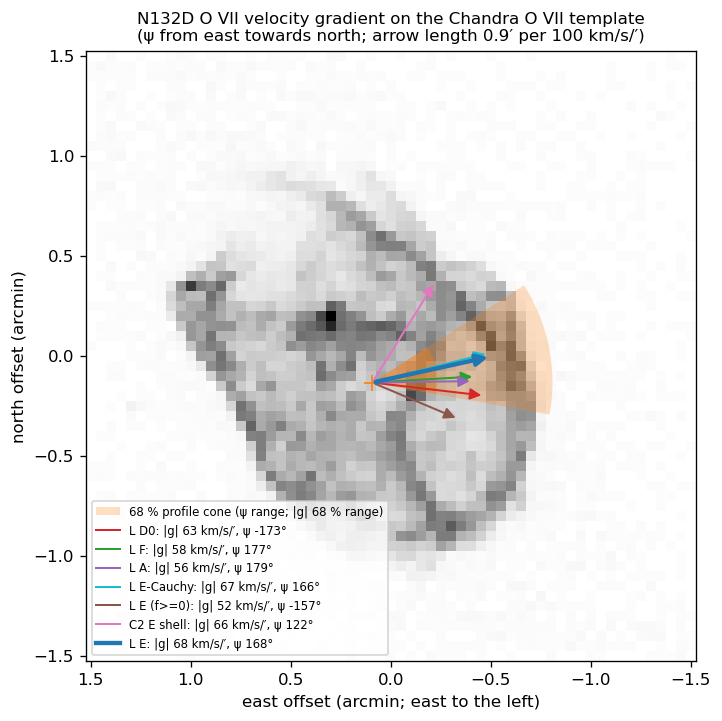
/u/Lang3/Data/S2Fitting/verification/e018b-stage1-opus-20261017/results/fig_velocity_field.png(SHA256 620b8ad280b05b5e)。Figure 1: the stage-one O VII narrow-band velocity fit (observation 0210681301, model L). Left: the fitted velocity-field arrows on the sky template, whose length and direction give the planar gradient's magnitude and position angle. Right: the bulk velocity \(v_0\) (top) and the velocity dispersion \(\sigma_v\) (bottom) in five nuisance configurations (D0, F, A, E, E-Cauchy); the dashed horizontal line is the 85 km s\(^{-1}\) limit on unmodelled instrumental broadening. All five configurations agree on the dispersion. Source: /u/Lang3/Data/S2Fitting/verification/e018b-stage1-opus-20261017/results/fig_velocity_field.png (SHA256 620b8ad280b05b5e).4.2 发射气体相对大麦哲伦云静止,零点定在一个像素的十分之一尺度上4.2 The emitting gas is at rest in the Large Magellanic Cloud frame, with the zero point pinned to a tenth of a pixel
速度零点 \(v_0 = 12 \pm 21\) km s\(^{-1}\) 与 LMC 一致。按色散定律,21 km s\(^{-1}\) 在 21.8 Å 处只相当于 0.0016 Å,约 0.013 角分的交叉色散偏移——零点定在一个 XDSP 像素的十分之一尺度上,靠的是三个滚转角互相约束。这个"零"是一个测量结果,不是假设:波长零点完全交给数据,没有加外部约束。The velocity zero point \(v_0 = 12 \pm 21\) km s\(^{-1}\) agrees with the LMC. By the dispersion law, 21 km s\(^{-1}\) at 21.8 Angstrom is only 0.0016 Angstrom, about 0.013 arcmin of cross-dispersion — the zero point is pinned to a tenth of an XDSP pixel, and that comes from the three roll angles constraining each other. This "zero" is a measurement, not an assumption: the wavelength zero point is left entirely to the data, with no external constraint.
4.3 速度梯度只有 1.9\(\sigma\),且随谱线模板模型改变4.3 The velocity gradient is only 1.9 sigma and changes with the line-template model
平面速度梯度拟合给出 \(|g| = 68 \pm 31\) km s\(^{-1}\) 每 5 角分(1\(\sigma\) Fisher):梯度幅度只是 1.9\(\sigma\) 的探测,方向不稳健(不同先验下转动),因此我们只把它作为上界报告,不作为方向性结论[s5]。同一次拟合还给出条带间速度尺度 \(\sigma_c = 438 \pm 28\) km s\(^{-1}\) 与条带间速度零点 \(v_s = -99 \pm 43\) km s\(^{-1}\)(1\(\sigma\) Fisher):按色散符号把天空分成两半、各给一个速度偏移,拟合改善 \(\Delta C = -101\)(4 个参数),但每半仍需约 440 km s\(^{-1}\) 的弥散,说明宽度主要是内部运动,不是大尺度梯度[s5]。The planar velocity-gradient fit gives \(|g| = 68 \pm 31\) km s\(^{-1}\) per 5 arcminutes (1-sigma Fisher): the gradient magnitude is only a 1.9-sigma detection and its direction is not robust (it rotates under different priors), so we report it as an upper limit only, not as a directional claim[s5]. The same fit also returns the inter-strip velocity scale \(\sigma_c = 438 \pm 28\) km s\(^{-1}\) and the inter-strip velocity zero-point \(v_s = -99 \pm 43\) km s\(^{-1}\) (1-sigma Fisher): splitting the sky by dispersion sign and giving each half its own velocity offset improves the fit by \(\Delta C = -101\) (4 parameters), but each half still needs about 440 km s\(^{-1}\) of dispersion, so the width is mostly internal motion, not a large-scale gradient[s5].
4.4 禁戒线 f 的天空分布与共振线不同,梯度幅度随模板模型从 66 降到 32 km s\(^{-1}\) 每角分4.4 The forbidden line f has a different sky distribution from the resonance lines, and the gradient falls from 66 to 32 km s\(^{-1}\) per arcmin with per-line templates
用一个 Chandra 模板同时描述 O VII 三重线的 r、i、f 三条线并不成立。在 0.01′ 的细网格上把 f 线的模板作为两个自由参数拟合,得到内部最优解:偏移 \((\delta x, \delta y)_f = (-1.04 \pm 0.63,\, +3.62 \pm 0.52)\)″,北向分量 7.0\(\sigma\),拟合改善 \(\Delta C = -53.45\)(2 个参数);两个起点给出一致结果[s15]。共振线 r 拒绝同样的平移,而 i 线弱约束。没有任何 Chandra 波段图像具有所需的形态:O VIII 与 Fe-L 波段偏南,不偏北。网格假象已被排除。One Chandra template does not describe the r, i and f lines of the O VII triplet together. On the 0.01 arcmin fine grid, fitting the f-line template offset as two free parameters gives a well-defined interior optimum: \((\delta x, \delta y)_f = (-1.04 \pm 0.63,\, +3.62 \pm 0.52)\) arcsec, a northward component of 7.0 sigma, with the fit improving by \(\Delta C = -53.45\) (2 parameters); two starts agree[s15]. The resonance line r rejects the same shift, while the i line is weakly constrained. No Chandra band image has the required morphology: the O VIII and Fe-L bands are displaced south, not north. A grid artefact is excluded.
对速度参数的影响是选择性的:只放开 f 的偏移时,\(v_0\) 移动 \(+12\) km s\(^{-1}\)(0.58 SD)、\(\psi\) 移动 \(+7^\circ\)(0.33 SD)、\(|g|\) 移动 0.17 SD,\(\sigma_v\) 不变(497 km s\(^{-1}\))。把 r、i、f 全部放到各自的模板上,\(|g|\) 从 66 降到 32 km s\(^{-1}\) 每角分,\(\sigma_v\) 降到 471 km s\(^{-1}\)[s15]。因此 \(\sigma_v \approx 470\)-500 km s\(^{-1}\) 对谱线模板模型是稳健的,而梯度幅度不是:它取决于每条谱线的天空分布怎么建模。这一系统误差与统计误差相加,是当前梯度读数的主要不确定性来源;它是天区原因还是仪器原因,由正在进行的检验判定(待定)。The effect on the velocity parameters is selective: with only the f offset freed, \(v_0\) moves by \(+12\) km s\(^{-1}\) (0.58 SD), \(\psi\) by \(+7^\circ\) (0.33 SD) and \(|g|\) by 0.17 SD, while \(\sigma_v\) is unchanged (497 km s\(^{-1}\)). With r, i and f each on their own template, \(|g|\) falls from 66 to 32 km s\(^{-1}\) per arcmin and \(\sigma_v\) to 471 km s\(^{-1}\)[s15]. So \(\sigma_v \approx 470\)-500 km s\(^{-1}\) is robust to the line-template model, while the gradient magnitude is not: it depends on how each line's sky distribution is modelled. This systematic adds to the statistical error and is the dominant uncertainty in the current gradient reading; whether its cause is sky or instrumental is under test (pending).
4.5 两个窄带都不通过泊松拟合优度检验,速度数值以速度模型为条件4.5 Both narrow bands fail the Poisson goodness-of-fit test, so the velocity numbers are conditional on the velocity model
这是当前的主要限制,必须与速度数值一起读。O VII 波段:配置 E 的实测 Cash 统计量 1337.7 与 250 次模拟再拟合的 \(982.3 \pm 45.0\) 相比,超出 7.9 个模拟标准差(0 次达到;\(p < 0.004\));失配集中在亮的 O2/O3 条带,是结构化的谱线形状残差,不是整体偏移[s5]。O VIII 波段:配置 A 的实测统计量 1991.2 对 200 次模拟再拟合的 \(1383.8 \pm 54.8\),超出 11.1 个标准差,0 次达到(\(p = 0.005\))[s14]。图 2 给出 O VII 的逐条带残差:亮的条带呈平顶或双峰,单高斯速度分布无法重现。This is the current main limitation and must be read together with the velocity numbers. For the O VII band, the observed Cash statistic of 1337.7 in configuration E compares with \(982.3 \pm 45.0\) from 250 simulated refits, an excess of 7.9 simulated standard deviations (0 reached it; \(p < 0.004\)); the misfit sits in the bright O2/O3 strips as structured line-shape residuals, not as a global offset[s5]. For the O VIII band, the observed statistic of 1991.2 in configuration A compares with \(1383.8 \pm 54.8\) from 200 simulated refits, an excess of 11.1 standard deviations, with 0 reaching it (\(p = 0.005\))[s14]. Figure 2 gives the per-strip residuals for O VII: the bright strips are flat-topped or double-peaked, which a single Gaussian velocity distribution cannot reproduce.
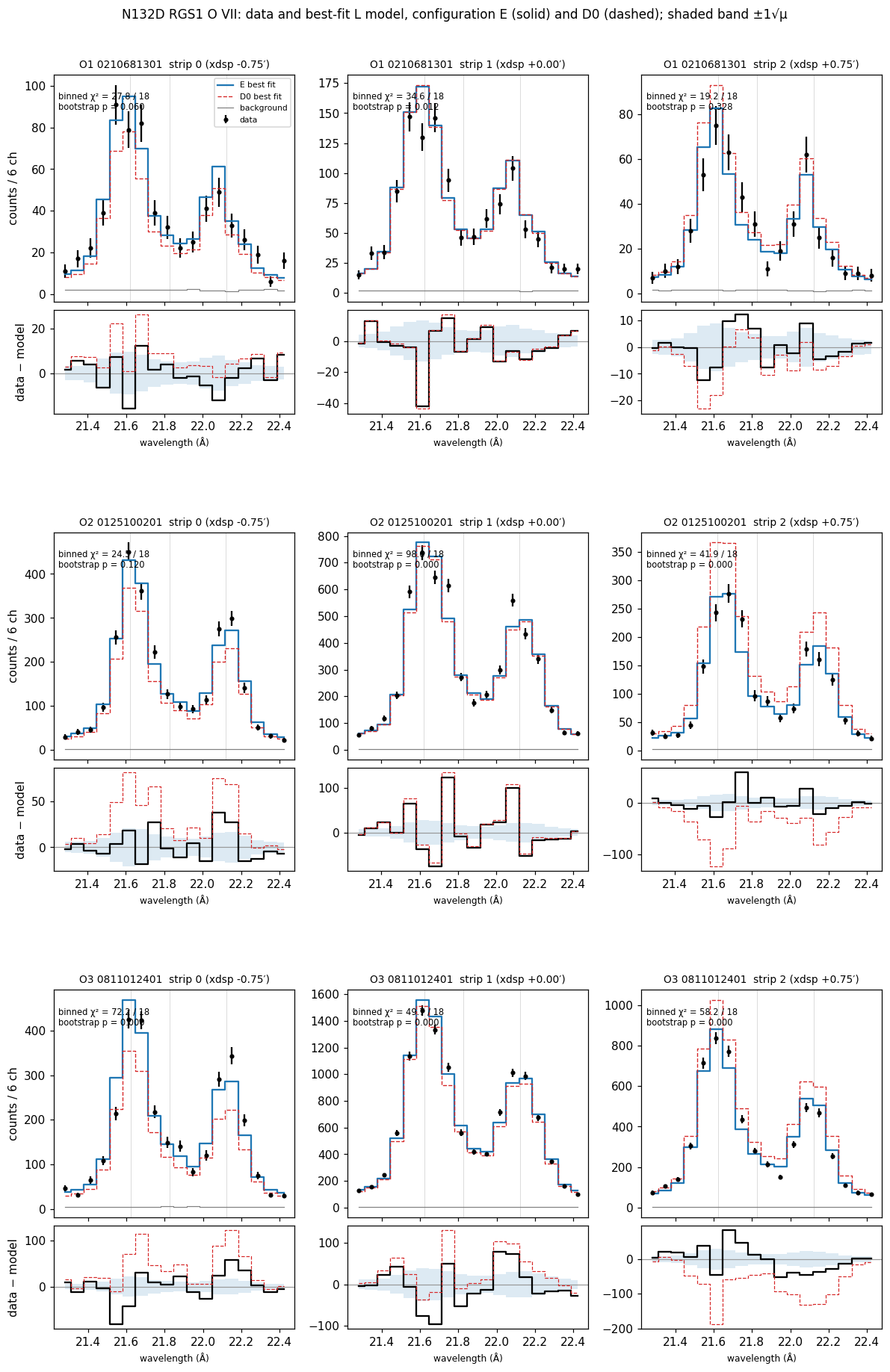
/u/Lang3/Data/S2Fitting/verification/e018b-stage1-opus-20261017/results/fig_residuals.png(SHA256 c92b9b858160440f)。Figure 2: the per-strip normalised residuals of the O VII stage-one fit (three strips each for observations 0210681301, 0125100201 and 0811012401, 21.25-22.45 Angstrom). Wavelength is horizontal and the normalised residual vertical; the dotted lines are the \(\pm 3\) reference. In the brightest O2/O3 central strips the model peak is too high near 21.65 Angstrom and too low on both sides, a structured excursion — the visual form of the goodness-of-fit failure (an excess of 7.9 simulated standard deviations). Source: /u/Lang3/Data/S2Fitting/verification/e018b-stage1-opus-20261017/results/fig_residuals.png (SHA256 c92b9b858160440f).因此本稿的所有速度数值——O VII 的 \(\sigma_v\)、\(v_0\)、\(|g|\) 与 O VIII 的对应值——都只能在与"一个平面场加一个高斯弥散"这个速度模型相同的条件下理解。拟合优度为何不合格、以及换用更自由的速度分布(例如接近与远离的两个壳层成分)后数值如何变化,由第二阶段诊断(待定)。Every velocity number in this draft — the O VII \(\sigma_v\), \(v_0\) and \(|g|\), and the O VIII counterparts — is therefore understandable only under the same velocity model of a plane field plus one Gaussian dispersion. Why the goodness of fit fails, and how the numbers change under a freer velocity distribution (for example separate approaching and receding shell components), is the stage-two diagnosis (pending).
4.6 O VIII 窄带的第一阶段拟合4.6 The stage-one fit of the O VIII narrow band
O VIII 窄带(18.40–19.40 Å)的第一阶段拟合给出:梯度幅度 \(|g| \approx 111\) km s\(^{-1}\) 每 5 角分,方向 \(\psi \approx -16^\circ\),与 O VII 梯度的方向相差 176°;速度弥散 \(\sigma_v \approx 412\) km s\(^{-1}\)[s14]。图 3 给出该拟合在天空模板上的速度箭头与逐条带残差。但如 4.5 节所述,它的拟合优度同样不合格(\(p = 0.005\)),所以这些数值不能作为 O VIII 的独立结论,更不能支持"两个电离阶段反向运动"的物理解读。The stage-one fit of the O VIII narrow band (18.40-19.40 Angstrom) gives: a gradient magnitude \(|g|\) of about 111 km s\(^{-1}\) per 5 arcminutes at a position angle \(\psi \approx -16^\circ\), 176 degrees from the O VII gradient direction, and a velocity dispersion \(\sigma_v \approx 412\) km s\(^{-1}\)[s14]. Figure 3 gives that fit's velocity arrows on the sky template and its per-strip residuals. But as section 4.5 states, its goodness of fit fails as well (\(p = 0.005\)), so these numbers are not an independent O VIII conclusion and do not support the physical reading that the two ionisation stages move in opposite directions.
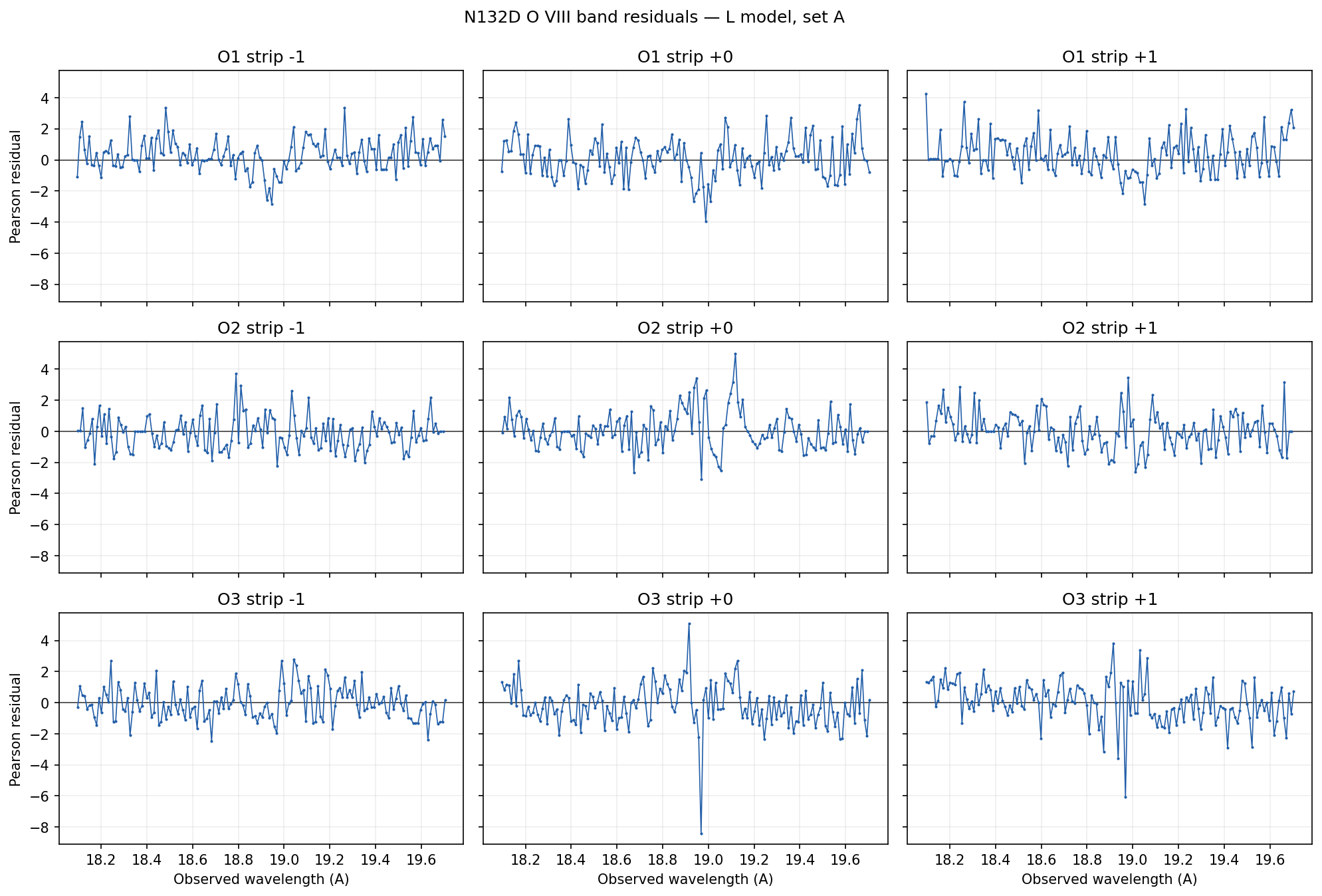
/u/Lang3/Data/S2Fitting/verification/e023-oviii-stage1-luna-20261019/fig_residuals.png(SHA256 cc8dc357c1c32c18)。Figure 3: the stage-one O VIII narrow-band fit (configuration A). Top: the per-strip residuals, with large structured excursions in the brightest O3 central strip, consistent with the \(p = 0.005\) goodness of fit. Bottom: the fitted velocity arrows on the sky template. Source: /u/Lang3/Data/S2Fitting/verification/e023-oviii-stage1-luna-20261019/fig_residuals.png (SHA256 cc8dc357c1c32c18).5. 讨论5. Discussion
\(\sigma_v = 500\) km s\(^{-1}\) 的弥散与 N132D 的年轻年龄(约 2500 年)和 Chandra 像斑(knots)的膨胀速度一致,支持“氧发射来自快速膨胀的喷出物”的解释。但弥散也可能部分来自未被分辨的子结构(速度梯度就是其中之一),因此对 \(\sigma_v\) 的解释要保留这一系统不确定性[s1]。A dispersion of \(\sigma_v = 500\) km s\(^{-1}\) is consistent with N132D's young age (about 2500 years) and the expansion speeds of its Chandra knots, supporting the interpretation that the oxygen emission comes from fast-expanding ejecta. But the dispersion may also come partly from unresolved substructure (the velocity gradient is one such component), so the interpretation of \(\sigma_v\) must carry this systematic uncertainty[s1].
本方法的关键限制是方向信息的损失:RGS 把天空位置折叠进波长,一条条带内的多个子结构贡献不可分的谱。多滚转观测只能部分恢复方向,三个滚转角不能把二维速度场完全解缠。第二阶段的更细网格(65 个位置对 11 个节点)会量化这个极限[s11]。The key limitation of the method is the loss of directional information: the RGS folds sky position into wavelength, and multiple substructures inside one strip contribute inseparable spectra. Multi-roll observations recover direction only partly; three roll angles cannot fully disentangle a two-dimensional velocity field. The stage-two finer grid (65 positions versus 11 nodes) will quantify this limit[s11].
当前的主要限制不是仪器误差,而是模型失配:两个窄带都不通过泊松拟合优度检验(O VII 超出 7.9 个模拟标准差,\(p < 0.004\);O VIII 超出 11.1 个,\(p = 0.005\)),失配集中在亮条带的结构化谱线形状残差(图 2、图 3)。因此本稿的所有速度数值都以"一个平面场加一个高斯弥散"这个速度模型为条件;它们是模型条件下的最佳读数,不是无条件的物理测量。换用更自由的速度分布(例如接近与远离的两个壳层成分)后数值如何变化,由第二阶段诊断(待定)。The current main limitation is not instrumental error but model misfit: both narrow bands fail the Poisson goodness-of-fit test (O VII exceeds by 7.9 simulated standard deviations, \(p < 0.004\); O VIII by 11.1, \(p = 0.005\)), and the misfit sits in structured line-shape residuals in the bright strips (Figures 2 and 3). Every velocity number in this draft is therefore conditional on the velocity model of a plane field plus one Gaussian dispersion; they are best readings under that model, not unconditional physical measurements. How the numbers change under a freer velocity distribution (for example separate approaching and receding shell components) is the stage-two diagnosis (pending).
O VIII 与 O VII 的梯度方向相差 176°,两者近乎反向。两种物理解释尚未分开:一种是两个电离阶段的发射区确实朝相反方向运动(例如反向激波与外层喷出物),另一种是 O VIII 的谱线清单或天空模板仍不完整,使拟合把形状失配读成速度梯度。两个窄带同样不合格的拟合优度支持后者的可能性,所以本稿不断言 O VIII 的梯度方向[s14]。The O VIII and O VII gradient directions differ by 176 degrees, so they are nearly antiparallel. Two physical readings are not yet separated: either the two ionisation stages genuinely move in opposite directions (for example a reverse shock and outer ejecta), or the O VIII line list or sky template is still incomplete, so the fit reads a shape mismatch as a velocity gradient. The equally failing goodness of fit in both narrow bands supports the second possibility, so this draft makes no claim about the O VIII gradient direction[s14].
6. 总结6. Summary
我们发展并验证了一个多滚转 RGS 前向建模流程,它把展源的仪器算子、讨厌参数组与统计框架组合成一个可审计的测量。N132D 的 O VII 三重线测量给出:LMC 静止系中的速度弥散 \(\sigma_v = 500 \pm 27\) km s\(^{-1}\)(对谱线模板模型稳健,每线独立模板下 471 km s\(^{-1}\)),速度零点与 LMC 一致,平面梯度幅度 \(|g| = 68 \pm 31\) km s\(^{-1}\) 每 5 角分(1.9\(\sigma\),仅作上界;每线独立模板下从 66 降到 32 km s\(^{-1}\) 每角分)。禁戒线 f 的天空分布与共振线不同(北移 \(3.62 \pm 0.52\)″,\(\Delta C = -53.45\)),是梯度读数的主要系统误差来源。方法误差经标定源审计、注入检验与点源实测三重验证,速度偏差不超过 0.2 个标准差。两个窄带均不通过泊松拟合优度检验(O VII 超出 7.9 个模拟标准差,O VIII 超出 11.1 个),因此所有速度数值以"一个平面场加一个高斯弥散"的速度模型为条件;O VIII 的数值只作条件性结果报告。档案中另有 11 个观测已约简(388 ks),响应包与逐观测偏移完成后可把测量扩展到 14 个观测(待定)。We developed and validated a multi-roll RGS forward-modelling pipeline that combines the extended-source instrument operator, the nuisance set and the statistical framework into one auditable measurement. The O VII triplet measurement in N132D gives: a velocity dispersion \(\sigma_v = 500 \pm 27\) km s\(^{-1}\) in the LMC rest frame (robust to the line-template model, 471 km s\(^{-1}\) with per-line templates), a velocity zero-point consistent with the LMC, and a planar gradient magnitude \(|g| = 68 \pm 31\) km s\(^{-1}\) per 5 arcminutes (1.9-sigma, an upper limit only; it falls from 66 to 32 km s\(^{-1}\) per arcmin with per-line templates). The forbidden line f has a different sky distribution from the resonance lines (a northward shift of \(3.62 \pm 0.52\) arcsec, \(\Delta C = -53.45\)) and is the dominant systematic in the gradient reading. The method's errors were verified three ways — calibrator audit, injection tests and point-source measurements — with velocity biases within 0.2 standard deviations. Both narrow bands fail the Poisson goodness-of-fit test (O VII exceeds by 7.9 simulated standard deviations, O VIII by 11.1), so every velocity number is conditional on the velocity model of a plane field plus one Gaussian dispersion; the O VIII numbers are reported as conditional results only. 11 further archival observations are reduced (388 ks); once their response packs and per-observation offsets are done the measurement can extend to 14 observations (pending).
致谢、设施与软件Acknowledgments, facilities and software
本工作基于 XMM-Newton(欧空局)与 Chandra X-ray Observatory 的档案观测。软件:SAS(xmmsas_20211130_0941)、CIAO/Sherpa 4.18、Python(numpy、scipy、matplotlib、astropy)。数据约简与拟合遵守项目科学合同(docs/science-contract.md)。This work is based on archival observations from XMM-Newton (ESA) and the Chandra X-ray Observatory. Software: SAS (xmmsas_20211130_0941), CIAO/Sherpa 4.18, Python (numpy, scipy, matplotlib, astropy). Data reduction and fitting follow the project science contract (docs/science-contract.md).
数据可用性Data availability
XMM-Newton 与 Chandra 档案数据可经各自公开档案库获取(ObsID 见表 1)。拟合输入包与结果文件在项目数据目录下的 verification/ 子目录中,其哈希在 cognition-os 记录中登记。The XMM-Newton and Chandra archival data are available from their public archives (ObsIDs in Table 1). The fitting input packs and result files live under the verification/ subdirectory of the project data directory, with hashes registered in the cognition-os records.
参考文献References
本草稿为项目内部工作文档,正式投稿前将按 ADS 格式补全参考文献列表(RGS 仪器论文 den Herder et al. 2001, A&A 365, L7;XMM-Newton Jansen et al. 2001, A&A 365, L1;Cash 1979, ApJ 228, 939;N132D 相关文献待补)。This draft is an internal project working document; before formal submission the reference list will be completed in ADS format (RGS instrument paper den Herder et al. 2001, A&A 365, L7; XMM-Newton Jansen et al. 2001, A&A 365, L1; Cash 1979, ApJ 228, 939; N132D references to be added).
附录 A:来源映射(Source map)Appendix A: Source map
正文中每个 [sN] 标记的来源如下:Each [sN] marker in the text maps to:
- [s1] 来源:docs/science-contract.md;[s2] 来源:docs/architecture.md;[s3] 来源:cognition-os/00_AI_BRIEFING.md;[s4] 来源:cognition-os/03_TRUST_TABLE.md(色散定律);[s5] 来源:cognition-os/insights/I029_n132d-ovii-velocity-stage1.md;[s6] 来源:同前,I026;[s7] 来源:同前,I021;[s8] 来源:同前,E018b design (RT15);[s9] 来源:同前,E018b design (RT17);[s10] 来源:同前,I028;[s11] 来源:同前,E018c stage 2(在跑,待定);[s12] 来源:cognition-os/03_TRUST_TABLE.md E021、E022 行;[s13] 来源:同前,I029 (RT22) 行;[s14] 来源:同前,E023 行;[s15] 来源:同前,I029 (E025 修订) 行。[s1] Source: docs/science-contract.md; [s2] Source: docs/architecture.md; [s3] Source: cognition-os/00_AI_BRIEFING.md; [s4] Source: cognition-os/03_TRUST_TABLE.md (dispersion law); [s5] Source: cognition-os/insights/I029_n132d-ovii-velocity-stage1.md; [s6] Source: ibid., I026; [s7] Source: ibid., I021; [s8] Source: ibid., E018b design (RT15); [s9] Source: ibid., E018b design (RT17); [s10] Source: ibid., I028; [s11] Source: ibid., E018c stage 2 (in flight, pending); [s12] Source: cognition-os/03_TRUST_TABLE.md rows E021, E022; [s13] Source: ibid., row I029 (RT22); [s14] Source: ibid., row E023; [s15] Source: ibid., row I029 (E025 amendment).